
Potter Place Railroad Station
The Potter Place Railroad Station in Andover dates from 1874. It replaced an earlier depot that was built in 1847 when the Northern Railroad was under construction from Concord, NH to White River Junction in Vermont.
It has been identified by the New Hampshire Division of Historic Resources as the best preserved and the most architecturally important railroad station still standing in Merrimack County, NH, and perhaps the best 19th century wooden railroad station surviving in New Hampshire. It is listed on the National Register of Historic Places.
The architecture of this station is more dramatic than the modest designs of other surviving stations. It is an adaptation of the late 19th century Victorian Stick Style to railroad station design, with its stickwork, brackets, and bargeboards. The broad hip roof with slate covering, the wide overhanging eaves with large elaborate brackets, and the projecting bay window for the station manager’s office all add to the striking appearance of the station.
The interior of the station reveals much of its original function and appearance. The station master’s office retains total historic authenticity. There is the main waiting room, with its access to the ticket window. Also, there are the separate gents’ and lady’s waiting rooms, each with their adjoining rest rooms. The baggage room at the end of the station was later converted to a milk room where cans of milk were stored waiting for shipment on the early morning train to Boston.
The station now functions as a museum, displaying many of the artifacts in the Andover Historical Society’s collection. Annually a special exhibit is mounted featuring a particular aspect of the history of the Town of Andover. Previous exhibits have featured Andover’s summer camps, Andover sports, and Andover’s special people and places.
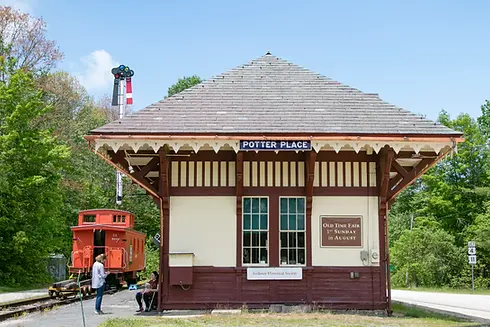

Caboose CV-4030
On the track beside the Potter Place Railroad Station sits a well-preserved caboose. Identified as CV-4030 from the Central Vermont Railroad, this caboose dates from 1907. It retains all of its historically interesting features. There is the cupola for monitoring the train cars, there are the racks for the safety flares, there is the pot-bellied stove for warmth, the ice box for the engineer’s provisions, and the bunk bed for overnight duty.
All are welcome to visit our caboose and imagine the life of a railroad brakeman, sitting up in the cupola and monitoring the cars ahead, as the train wended its way through the winding track amongst the hills and valleys of New Hampshire.
The history of the train’s caboose is interesting. For more than a century, the last car on a train was the caboose. A little shack on wheels, it served as office, bedroom, and kitchen for the train crew. Its cupola was an observation deck from which the brakeman watched the train for shifting loads, overheated wheel bearings, and other problems.
“Caboose” is an old sailing term meaning a kitchen set up on the deck of a ship; it came to mean any portable or temporary shelter. The railroad caboose undoubtedly began as a tent or shelter set up on an old flatcar.
Richard Potter Gravesite
The village of Potter Place in the town of Andover is named for celebrated magician, ventriloquist, and showman Richard Potter (1783-1835), who made his home here from 1814 until his death in 1835. A small graveyard adjacent to the Potter Place Railroad Station contains his remains and those of his wife Sally.
According to church records, Richard Potter was born in 1783 in Hopkinton, Massachusetts, the son of a slave on the estate of Sir Charles Henry Frankland (who died 15 years before Potter’s birth). His father was George Simpson, a local minister. Potter was educated until he was ten years old when he went to England as a cabin boy. He traveled throughout England and perhaps elsewhere in Europe as a circus performer until 1801 when he returned to America as the assistant to John.
Potter was educated until he was 10 years old, when he went to England as a cabin boy. He traveled throughout England and perhaps elsewhere in Europe as a circus performer until 1801, when he returned to America as the assistant to John Rannie. He learned his craft from Rannie and started to perform on his own when Rannie retired in 1811.
He became a celebrity from Quebec to New Orleans and is described as “the most famous ventriloquist and sleight-of-hand performer of his day.”
Richard had often performed at Benjamin Thompson’s tavern in Andover and liked the area and the people. He purchased a 175-acre farm in 1814 and built a home that became a showplace. The neighborhood soon became known as “Potter’s Place.” In 1871, the post office made the area officially Potter Place.


J.C. Emons General Store
and Post Office
In the early years of the 20th century, the village of Potter Place was a beehive of activity. It was here that the Northern Railroad turned north from its westward course through Andover from Concord, Boston, and points further south. Travelers would continue on by coach (and later by autobus) to destinations further west, such as Lake Sunapee and New London.
A very active village developed at Potter Place to accommodate the traveling public in addition to the other railroad-related activities such as fresh milk shipment and other agricultural and commercial shipments. There was the imposing Hotel Potter, the Blackwater Manor boarding house, a stable, several restaurants, a pool hall, two general stores, and a post office.
The J.C. Emons General Store and Post Office is one of the remaining buildings from those active times. It was built in 1912 by George W. Weed as a general store. An extension was later added for the post office. The store continued in operation until 1958. The post office remained active until 1988. John C. Emons owned and operated the store in the years 1935 to 1940.
The building was donated to the Andover Historical Society by H. Everett Humphreys of Andover in 1994. The Society is recreating its appearance and ambiance as a general store with typical furnishings and materials of the era. Particularly interesting is the restored “tin” ceiling (in reality, sheet steel with a tin coating).
The post office retains the old lockboxes and customer window. Behind the window can be seen the sorting table where incoming mail was organized for delivery. A gift shop is located in the store, where books, videos, and other documents of Andover history are available. Also available are t-shirts and other items relating to Andover.
Northern Railroad Freight House
Located a short distance east along the tracks from the passenger station is the Potter Place freight house. This building is 60′ 6″ by 25′. A loading platform runs the length of the building along the adjacent spur track. Two sliding doors on the track side of the building provide access for transfer of goods to and from freight cars. A loading dock on the west end of the building provides for receipt and delivery of shipments.
An office space of 5′ 9″ by 25′ is partitioned off at the east end of the building. In this area is located a brick chimney and evidence of a heating stove (no longer present).
This building has hardly changed since the early 1900s. Examination of the roof beams shows that the building had been widened at some earlier time, perhaps to enlarge a previous structure.
The Andover Historical Society acquired this freight house in 2003 as a gift from the R.P. Johnson family, who owned a building supply company in Andover for three generations. The Society is adapting the large and open interior in this building to provide exhibition space for some of the larger and bulkier historic artifacts in its collection, such as agricultural machinery and tools.

B&M Freight Car
On June 12, 2009, B&M Freight Car 745034 arrived at the Andover Historical Society Museum at Potter Place on a flatbed trailer. This concluded a process that took several years working with the State of New Hampshire to get permission to locate it within its right-of-way. Prior to that 745034 served as a ‘billboard’ sign for Capital Plumbing and Heating.
According to sources at the B & M RR History Museum the car is a 1956 Pullman-Standard 50′ boxcar with a gross weight of 110 tons. Given this tonnage, what is remarkable about the present condition of the trucks (railroad parlance for the undercarriage assembly) is the ease with which the car can be pushed by hand!
Some of the uses for this series included hauling bagged cement, packaged flour, spent grain, wood flour, meat refuse and food products. The car was renumbered “4503,” a special designator and was assigned to transport spent grain, the residue from the beer brewing process. This product would be taken to an animal feed manufacturer and used as an extender or filler in either pet food or farm animal food (ref. Al Campbell).
The car was originally painted blue with a black door and tracks and a large intertwined “B M” on the right side. The car has been repainted at least once. Other modifications included replacing the ladders on the right side with half ladders.
Of particular interest are the various markings on the sides. On a boxcar, there is an L half way up the car side ahead of the door and an R on the opposite side to designate the left and right side. The ACI plate, an early bar-code system that used an optical sensor alongside the tracks while the train was in motion, consists of a red, white and blue striped panel below the logo. The layout of colors is unique to 4503 and identified its use.
A second panel, called the lube plate, records maintenance. A third marking is a yellow wheel inspection dot. The dot indicates that the wheels are approved for type and load. Those having high carbon content were subject to cracking and were marked with a white dot. Cars repainted after 1978 had no dot markings.
Perhaps the most intriguing feature of 4503 that also proved to be the most frustrating is the paint color. Typically boxcars manufactured in the early 1900s were painted a rust-colored red, primarily due to cost. They were so predominant that paint companies now refer to some of their colors as “boxcar red.”
When Patrick McGinnis took over the B&M in 1955, he put a lot of effort into showy graphics. After several experiments, his designer produced a couple of boxcar schemes: the 50 foot PS-1s (77000 series) were delivered with a blue body and black door, with an interlaced BM herald in white (B) and black (M, with white trim) to the right of the door. A little later, the third order of 40 foot PS-1s (76000 series) was delivered with a blue body and door, with an interlaced BM herald in white (B) and blue (M, with a white border) on a black panel to the right of the door. Lettering remained white. Later boxcars used a simplified all-white herald (contributed by Tim Gilbert).
Since the time of its delivery 4503 has served as a storage unit for the Society, a rusted reminder of her glory days. While other major projects continued to occupy center stage, 4503 finally came to the head of the list. The Society’s president, Pat Cutter, announced that a committee consisting of Chris and Tim Norris and Arch Weathers had been formed to spearhead the project.
Three challenges quickly became apparent to the committee: determining the level of restoration, dealing with lead paint, finding a lead paint licensed contractor who was competent in all phases of the project. The committee felt strongly that cost should certainly be a consideration but not the limiting factor. We were all interested in delivering a product that accurately reflected the authenticity of the original design and thus started interviewing several companies.
We soon learned these guys don’t grow on trees; moreover, our concern focused on whether we could obtain more than one quote! In researching the first issue — an acceptable level of restoration — we were fortunate to discover Bob Cusack from Sherwin-Williams, who heads up the marine and protective coatings sales for the northeast. Bob recommended Jim Doherty from Target NE, a company that specializes in restorations of this nature and in whom Bob had confidence. We liked the idea of a contractor and supplier with a relationship and were able to negotiate a very fair price for the job.
Ultimately the committee decided the restoration should consist of sandblasting the entire superstructure except for the top and underside, but to include the trucks. We would use two protective primer coats with an epoxy base specially formulated by Sherwin-Williams followed by a finish coat of color. This combination would assure a high quality lasting finish. The last stage of restoring the lettering and logos would be done separately.
The final challenge was to determine the exact color code of the original paint. This proved to be the most difficult process. Neither the B&M folks nor the Railroad Historical Society could provide us a definitive answer. The literature was filled with references to B&M “boxcar blue,” photos were plentiful, but no formula could be found.
The answer, after days of searching the Internet and countless phone calls, came in a surprisingly simple manner. Model railroaders used one company for their paints — lo and behold, there was B&M boxcar blue in their online catalog! We ordered a sample. The Sherwin-Williams people scanned it, and the final piece of the puzzle was now in place.
AHS contracted with Target NE, a historic restoration outfit in Alton, NH to start work. The car was completely sandblasted with appropriate safety equipment and techniques required to safely remove and dispose of the blasting aggregate and paint. A special sealant primer coat followed by an epoxy base second primer prepared the surface for the final color. Each primer was properly tinted to blend with our “boxcar blue.”
While the finish coat was setting up, we started our search for someone who could detail the crucial B&M logo and identification numbers. This had to be hand painted and required exceptional skill and artistry. Just as important was our deadline requirement of August 5: the annual Old Time Fair at Potter Place, where the boxcar would be on display. Dale Flewelling of Art Attack met all requirements and was eager to be a part of this historic project.
Today, the hard work of these individuals can be viewed at the AHS museum headquarters at Potter Place. Take a stroll down there and witness a piece of railroad memorabilia. Live for a moment back in time. Listen: the clickety-clack of steel upon steel, the groan of shifting underpinnings, the slow, relentless advance as 4503, fully loaded, reaches the top of the grade, then the long giddy coast down the other side.
A final salute of the engine whistle — two short, one long — signals the end of the run; the hiss of air brakes, a night watchman’s lantern signal, one final lurch, then quiet. Freight car 4503 belongs to history.
Tucker Mountain Schoolhouse
The Tucker Mountain Schoolhouse was constructed in 1837 and served its local community until 1893, when dwindling student population led to its closing. It stands today in its original setting and location, in very good condition, looking much as it did when it was in active use.
It consists of a single room, measuring 16 feet by 18 feet. Attached is an “ell” or shed that serves as a weather-breaking entrance to the school building and also provides storage space for firewood. A small closet in the shed contains the two-hole privy. The building is of post-and-beam construction, using hand-hewn timbers fastened with trunnels, and sits on a foundation of unmortared granite stones. The walls are sheathed with vertical planks, covered externally with clapboards.
The pupils’ heavy plank desks stand bolted to the floor as they were. The floor slopes downward on two sides toward the center of the room, increasing visibility for the pupils in the back rows (a frequently-seen design detail in the schools of this time). The interior walls are covered with wide pine boards painted flat black to serve as chalkboards.
The building is listed on the National Register of Historic Places and now serves as a museum exhibiting details of an earlier way of education. The museum is open from 1 to 3 PM on the second Sunday of the month from June to October (though due to the COVID pandemic, it is closed for the 2020 season). You can enjoy a 16-minute video tour of the schoolhouse here.
In 2010, a video reenactment was created of a day at the Tucker Mountain Schoolhouse in the 1800s. Inspired by an 1887 photograph, with local youth as the actors, the video lasts 10 minutes and can be viewed here.


Concord Stagecoach
The Concord Stagecoach was owned by the Andover Lions Club and manufactured almost entirely by hand in Concord, New Hampshire by the Abbot-Downing Company. The firm built more than 3,500 coaches during the period 1827 to 1919 delivering them worldwide.
In Andover, the Concord Stagecoach was used for public transportation to and from distant locations up to the time when the Northern Railroad was completed through the Andover valley in 1847. Thereafter, the Concord Stagecoach continued in use for shorter distances from the Railroad Station to nearby destinations including New London, Elkins, Wilmot, and the Winslow House on Mount Kearsarge. Because of its location at the junction of roads in all directions, Potter Place became the most active of the four railroad stops in Andover with a concentration of services for trains, stagecoach connections, passengers, and freight transfers.
The bustling Potter Place center of the 1800s and early 1900s gave way to quieter times as the automobile increasingly became popular and most convenient with paved roads and motorized vehicle service availability into the later 1900s and beyond.
In the spring of 1919, the second, and last, grand Hotel Potter was destroyed by fire.
Fortunately, the fire did not spread to the “Hotel Potter Livery Stable,” so its contents (horses, carriages, and coaches) were not lost. Harry and Arthur Clark (Luan Clark’s grandfather and great-grandfather) were the proprietors at that time, and later that year the name of the livery was changed to “AA Clark & Son - Livery, Feed, and Exchange Stable”.
Then, in June of 1944, there was another large fire in Potter Place which took several of the buildings across the road from the Freight house, including the large Trow Store/RP Johnson & Son store house, and this time, the livery stable as well.
Thankfully the stagecoach, as well as several carriages, sleighs, and wagons, were being
housed in the livery’s large storage barn down at “The Horn” (“The Horn” is an area just
beyond the Potter Place depot, where the shim-shack, the conveyor house for coal transfer from freight car, the rail-car-hut, and the livery stable’s storage barn were.) So once again, the Concord coach was spared.
Bob Peters remembers that as a boy, he and friends would sneak into the locked barn (“I
don’t know how we got in!”) and climb up into the carriages and coach “for exciting adventures to places near and far”.
In 1955, the Andover Lions Club was formed. Wallace “Sam” Clark, the son and grandson of Harry and Arthur Clark, was a charter member of the Andover Lions Club and its first president. Two years later, he was the person responsible for securing the Concord coach for the Lions Club.
The Concord Stagecoach is a rare preserved example of the original public transportation vehicle that was essential for America’s beginning growth from early settlements to the establishment of major economic centers today. The stage coach was given to the town of Andover. Care of the coach is the responsibility of the Andover Historical Society (AHS). Many local contractors and volunteers are working together to build a barn to store and display Andover Concord Stagecoach. The structure will safely preserve our saved example of history while allowing townspeople and visitors to see an important feature in the life of Andover’s early heritage. Once the necessary funds are in hand the plan it to finish the construction in 2026. Please send your donation to Andover Historical Society, PO Box 167, Depot St., Andover, NH 03216. Add other payment options.
It seems fitting that the Concord stagecoach will once again reside in Potter Place.
Sources: Luan Clark and Bill Hoffman